Prompt Engineering Conference

Learn how to interact with the most advanced AI on our planet

November 26, 2026 London, UK

1
Day
30+
Speakers
3
Tracks
150+
Attendees

PEC is a worldwide series of community events for engineers, researchers and builders working with prompts, context and AI interaction. Across cities around the world, we bring together people designing and operating LLM-powered systems to share real-world techniques, compare approaches and explore how prompt engineering is evolving alongside agents, models and AI-native software.

Companies presenting:

all.health, AWS, Beat Saber, Blindsight, Busuu, Caringdots, Comply2Reg, Coral, Cursive, Echelon AI, FireHorse, GitLab, Great Wave AI, IBM, IFF Research, inDrive, LLM4S Foundation, NOFire AI, Optimizely, OTTRA, PhysicsX, Red Buffer, Reliaburger, SoftNet Technologies, Superagentic AI, The Trade Desk, Whitney AI, Wise


Topics so far:

Event Starts In:

Tickets

Schedule

November 26, 2026 • 3 parallel tracks • 9AM - 4PM • London, in‑person
View
Track 1 • screen 1

09:00

Coral Keynote

09:30

Miko Pawlikowski

KeynoteTen years of Kubernetes lessons, in one binary

Reliaburger
Before your first container hits production on Kubernetes you install a distro, a CNI, an ingress, cert-manager, Prometheus, Grafana, Loki, ArgoCD and Harbor. None of them is your app. 57% of Kubernetes users run more than 11 separate components, the control plane is a pet that needs restoring from backup at 3am, and "why can't A talk to B?" sends you through DNS, Endpoints, kube-proxy, iptables, CNI logs and NetworkPolicy. I have been evaluating, running and being paged for Kubernetes since 1.0 in late 2015, and I kept notes. This year I stopped complaining and built the thing: Reliaburger, a container orchestrator in Rust that ships scheduling, gossip membership, Raft, eBPF service discovery, ingress, mTLS, an image registry, metrics, logs, GitOps and chaos testing in one binary, driven by TOML. An app with health checks, ingress and autoscaling is twelve lines. There is no overlay network, no CNI and no kube-proxy: a name, a virtual IP and about 390 lines of C in the kernel. The talk covers the four scars and what Reliaburger does about each: apps instead of pods, a control plane that is elected rather than installed, SWIM gossip on one slide, and one connection from web to redis step by step. It also covers what it cost to build with Claude and Codex (200 hours and about a thousand pounds for roughly 220k lines of Rust), the rules that kept the models from doubling the codebase every week, the design we got wrong, and what Reliaburger deliberately does not do. Then a live demo, if the demo gods allow. It is 0.2.0, free and Apache 2.0. Download it, break it, tell me.... Read more

10:00

Hello London!!! - short Intro to Prompt Engineering Conference

Screen 1

10:10

Coffee break

Main lobby

10:30

Alper Nebi Kanli

Interpretability x Retrieval: Inside the Models That Power Search

Optimizely
Embedding models for retrieval have long been treated as black boxes. That has started to change. A young research field at the intersection of mechanistic interpretability and information retrieval has begun opening retrievers up, and the findings quickly turn into capabilities: embeddings that unfold into interpretable latent terms, so you can actually read why a document matched; sparse features usable as an indexing vocabulary in their own right; and relevance signals you can locate and steer, changing what a retriever favours without retraining it. This talk is a tour of these findings and what they make possible in practice, including what the same lens reveals about classic failure modes such as hub documents and collapsing multi-intent queries.... Read more

11:00

Martina Wyss

AI Can Read the Patient. But Can It Understand the Human? Beyond the Chatbot: Designing LLMs for Healthcare People Can Actually Trust

Caringdots
Most LLM-in-healthcare talks come from one side or the other: either the clinical side, which tends to stay conceptual, or the engineering side, which tends to treat "clinical context" as a footnote rather than a design constraint. I sit across both — as a registered nurse and clinical advisor with extensive hands-on experience, and as a product developer who now builds and architects these systems directly. That combination is rare, and as a woman working in a space that's still heavily engineering-dominated, it's a perspective I don't think gets enough airtime either. It's exactly what lets a talk like this go deep on the technical side without losing what actually makes these systems safe or dangerous in a real ward.... Read more

11:30

Emmanuela Opurum

Designing Production-Grade Prompt Systems for AI Agents: A Solution Architect’s Perspective

SoftNet Technologies
Prompt engineering has evolved from simple input crafting into a core architectural discipline for building reliable AI systems and agent-based applications. However, most implementations fail when they move from experimentation to production due to lack of structure, evaluation, and system-level design. In this talk, we explore prompt engineering as an architectural layer within modern AI systems, focusing on how to design prompts that are maintainable, observable, and scalable in real-world applications. We will cover: How prompt engineering fits into end-to-end AI system architecture Designing structured prompts for AI agents and tool-using systems Prompt lifecycle management: versioning, testing, and evaluation Failure modes: hallucination, prompt injection, and unstable outputs Meta-prompting patterns for dynamic and adaptive systems How solution architects should design prompt pipelines in production environments By the end of this session, attendees will understand how to move from ad-hoc prompt writing to systematic prompt engineering as part of a production architecture for AI agents and LLM-based systems.... Read more

12:00

Veronika Ulanova

When the Ground Truth Disagrees: What Atmospheric Blocking Teaches Us About Scientific AI

PhysicsX | Independent Researcher
In machine learning, we often evaluate models against an established ground truth, treating the resulting metrics as evidence of how well a model performs. But what happens when the ground truth itself depends on assumptions, competing definitions, or scientific objectives that aren't necessarily black and white? I've been exploring this problem through independent research into atmospheric blocking — large-scale atmospheric patterns associated with prolonged heatwaves and other extreme weather events. Despite decades of scientific study, there is no single universally accepted definition of atmospheric blocking. Established detection methods can disagree about whether an event occurred, when it began, or how long it lasted. This raises a question that goes beyond the reliability of training labels: before deciding whether a model is right or wrong, shouldn't we first establish what we're actually trying to achieve? A model trained to reproduce an established blocking detection method might achieve excellent accuracy against its reference labels. But does that mean it has learned something scientifically meaningful? Would a different definition be more useful for understanding extreme weather? And how can we design experiments that challenge our assumptions rather than simply reinforce them? In this talk, I'll use atmospheric blocking as a case study to explore how scientific objectives, assumptions and definitions shape the way we train and evaluate AI systems. We'll examine why apparently contradictory labels can both be defensible, how evaluation metrics can reward the wrong behaviour, and how to build validation frameworks that help us test whether our underlying assumptions are actually useful. Although the examples come from climate science, the implications extend to LLMs, AI agents and automated scientific discovery, where success is often subjective, multidimensional or difficult to measure. The challenge isn't always determining which answer is correct. Sometimes it's recognising that we've been asking the wrong question.... Read more

12:30

Artemis Leonardou

Three Hours Debugging Code I Never Wrote

NOFire AI
An agent wrote a change. It passed review, it passed CI, and then it took a production path down for about three hours. Nothing in the diff was wrong on its own, which is exactly why it got through, and the failure only existed in the combination of the edits. I have been shipping AI-generated code to production since I was fourteen, and this incident changed how I work more than anything else has. It took far longer to diagnose than an equivalent bug I would have written myself, and the reason was not the code. It was that I could not ask the author what they had intended, and none of the reasoning behind the change existed anywhere. Commit message, pull request, ticket: nothing. This talk is that incident, and then the three checks I have run ever since. Keeping a change small enough that reverting it is genuinely one step, rather than a careful unwind at three in the morning. Actually testing that the revert works instead of assuming it will. And moving the policy check to before an action executes rather than alerting after it has already landed. I will be honest about what each one costs in shipping speed, because none of them are free. Tool-agnostic, no live demo, nothing to install. If you are handing more of your pipeline to agents this quarter, this is the failure mode I wish someone had described to me first.... Read more

13:00

Lunch & networking

Main lobby

14:00

Kayode Adeniyi

Closing the satellite observation gap for flood insurance with AI Agents

AI Research Engineer
Parametric flood insurance pays without a claim. A satellite confirms water above a stated depth and the money moves. Organisations are buying it now for informal settlements across Africa and Asia, and the trigger has a gap. Standard Sentinel-1 thresholding over eight documented floods in dense neighbourhoods detects none of them, because side-looking radar over packed low-rise building never sees the ground, and turbid water sits close to dry concrete in backscatter. The instrument is blind where the policy is sold. This session closes that gap with an agent, and spends most of its time on the design work that makes such an agent safe to point at money. We'll go end to end. How a spoken report in a low-resource language becomes a calibrated measurement. How it is priced, so one report is worth a measured quantity with a ceiling set by your own model's skill. How evidence accumulates until a zone crosses the payout line. Then the constraints. A toolset with no capability to broadcast a public warning. Repeat reports from one handset adding no weight. Evals that catch the agent leading a witness. A payout computed in deterministic code a loss adjuster can rerun a year later and reproduce exactly. You'll leave with the shape of all of it, and an honest account of where it is still weak.... Read more

14:30

Oliver Gooding

Evaluating LLM Outputs When Quality is Subjective

IFF Research
Most eval advice assumes you can check the answer. But a lot of high-stakes LLM work has no definitive answer- like qualitative coding, thematic analysis, narrative findings. These are outputs where two expert humans will legitimately disagree, and where "correct" is a judgement rather than a match. In UK government social research, those outputs feed policy decisions, so "the model seemed confident" is not an acceptable standard of proof. This talk covers how we've approached validation in that environment: separating the parts of a pipeline that do have ground truth from the parts that never will, building statistical validation harnesses for the former, and designing human-in-the-loop review that catches failure in the latter. I'll cover what we measure, what we deliberately don't automate, and the failure modes we've hit. Attendees will leave with a practical framework for deciding which parts of a subjective pipeline can be evaluated algorithmically, which need human judgement by design, and how to defend either choice to a sceptical client.... Read more

15:00

Aleem Khan

Detecting 70 Kinds of Bias with a Model You Own: Replacing LLM API Calls in a Real-Time News Pipeline

Independent
Prompting a frontier LLM to flag bias in news works well in a demo. In production, with articles arriving continuously from publishers and social media, the cost, latency and inconsistency soon become a problem. This talk describes how we built a system that classifies around 70 types of bias (from framing and omission to loaded language and ideological slant) and rewrites stories to be balanced. We began with LLM prompts, used their outputs plus human review to build a large, politically balanced dataset of news stories, and trained an in-house model that replaced most of the API calls. You'll see how we designed the taxonomy, how we kept the dataset balanced, where prompting still beats the small model, and the human-in-the-loop checks that stop "debiasing" from turning into censorship. I'll also cover how we measured cost, latency and agreement with human reviewers before and after the switch. Key takeaways A practical path from prompt prototype to labelled dataset to an owned model Designing and balancing a multi-label bias taxonomy Where to keep humans in the loop, and how to measure fairness... Read more

15:30

Zoe Yan

Agents Meet the System of Record: Putting AI to Work Inside Enterprise Systems

Echelon AI
Large language models appear remarkably capable in isolation until they meet the systems the business actually runs on: ERP, ITSM, HR and procurement platforms with decades of customisation, undocumented integrations and hard-won internal standards. The bottleneck is rarely the model; it is context, data quality and governance. In this talk, I will walk through practical patterns for giving agents a reliable map of an organisation's systems, processes and dependencies; making instances and data "AI-ready" before agents touch them, and keeping humans in the loop with approval gates, standards checks and documentation trail, whether a person or an agent made it. We’ll explore what it takes to move from agents that can call enterprise tools to agents that can safely reason about and act within complex enterprise environments.... Read more

16:00

Wrap up

Scan each other's QR codes & head to a nearby pub!
Track 2 • screen 2

10:00

Hello London!!! - short Intro to Prompt Engineering Conference

Screen 1

10:10

Coffee break

Main lobby

10:30

Tahreem Rasul

The Agent Eval Stack: Outcomes, Trajectories, Reliability, and Judges

Red Buffer
Agent evaluation is often reduced to a final-answer score or an LLM-as-a-judge prompt. For real agentic systems, that is rarely enough. This talk presents a layered approach to evaluating agents across outcome correctness, environment state, trajectory quality, tool-use behavior, latency and cost, repeated-run reliability, and evaluator quality. It also looks at where deterministic checks work, where model-based judging is useful, and how trace-level evaluation can be combined with human calibration.... Read more

11:00

Kannupriya Kalra & Rory Graves

LLM4S 1.0: From Idea to Production AI in Scala/JVM

LLM4S Foundation & The Trade Desk
18 months after LLM4S kicked off, and one year after Kannupriya Kalra and Rory Graves showed a usable version on the Scala Days Switzerland stage, LLM4S has matured into a production-ready platform. In this talk, we’ll share the journey to LLM4S 1.0, from an ambitious idea for bringing first-class generative AI capabilities to Scala and JVM to a complete platform for building production AI applications. We’ll explore what worked, what failed, what we learned from building in one of the fastest-moving areas of technology, and why Scala’s type system and functional programming foundations have proved particularly valuable in the age of LLMs and agents. Along the way, we’ll demonstrate how LLM4S has evolved to support capabilities including multi-provider LLM integration, tool calling, MCP, agent orchestration, memory, observability, streaming, speech and multimodal AI, and production deployment patterns. Expect live demos, architecture diagrams, lessons from the open-source journey, and a practical look at what it takes to move from an AI experiment to a production-ready Scala application. Whether you have followed LLM4S from the beginning or are discovering it for the first time, you’ll leave with a clear picture of what LLM4S 1.0 can do, where the ecosystem is heading, and why your next AI project can be built in Scala.... Read more

11:30

Olushola Oladipupo

Before Your Agent Takes Action: Evaluating Customer-Service AI

AWS
A customer-service agent can give a convincing answer and still take the wrong action. Once agents can call tools, change records or pass work between agents, evaluating the final response alone is not enough. Using a published multi-agent customer-service reference implementation, this session will explore how to test what an agent does as well as what it says. We’ll walk through scenarios involving incorrect tool selection, missing information, failed actions and situations that require a human handoff. For each, we’ll examine what to check with deterministic tests, where model-based evaluation can help, and where human judgement remains necessary. Attendees will leave with a practical approach to building scenario-based evaluations and a reusable release checklist for deciding whether an agent is ready for a controlled pilot. The examples will use AWS services, while the evaluation principles apply across platforms.... Read more

12:00

Karthigeyan R J

Beyond RAG: Graph RAG & Small Language Models for Regulated Industries

Comply2Reg
Generalist RAG systems fail in high-stakes domains like finance. They can't handle the intricate cross-references and conditional logic of regulatory text, leading to hallucinations and making them untrustworthy. In this talk, I will share our practical journey building a domain-specific AI for regulatory compliance. We'll cover: 1. Architecture Evolution: Moving from standard vector RAG to a Graph RAG architecture that uses a regulatory ontology to understand relationships, not just retrieve text. 2. SLM Advantage: How combining Graph RAG with specialized Small Language Models (SLMs) yields higher accuracy, 80x lower cost, and drastically improved output stability compared to generalist LLMs . 3. Ensuring Reliability: A framework for synthetic data generation, benchmarking, and continuous evaluation to make inherently probabilistic AI systems auditable and reliable for production. We will include a practical architecture walkthrough and a live demo of our approach.... Read more

12:30

Peter Fox

From Rules to Reasoning: Migrating a Virtual Assistant to an LLM-Driven Orchestration Platform (Assisted by an AI Coding Agent)

IBM
This talk presents an automated regression testing framework designed to validate the migration of a virtual assistant from a rule-based, session-oriented conversational platform to a modern, LLM-driven orchestration platform. The framework replays multi-turn conversations against both systems in parallel and produces a side-by-side comparison of response quality, latency, and fallback behaviour, scored using two complementary text similarity metrics: Jaccard similarity for lexical overlap, and cosine similarity over sentence embeddings for semantic equivalence. A three-phase test runner coordinates live conversation capture, automated input replay, and a consolidated metrics report covering per-turn detail and unanswered-question coverage. The project was developed with the assistance of an AI-powered coding agent. The work establishes a repeatable, evidence-based process for verifying conversational parity and identifying gaps before full production cutover.... Read more

13:00

Lunch & networking

Main lobby

14:00

Guilherme Santos

Prompt Lawyering. How AI games human requests

Blindsight
Long before language models, we had AI systems that found clever ways to satisfy exactly what we asked for but not what we meant. An AI playing Tetris learned to pause the game before it lost, so it technically never lost. We laughed at the time, but the alignment problem behind it was never solved, and agents now have far more capabilities than just pausing a game. This talk is about what happens when an agent follows the request against the intent of its user: where that behaviour comes from, what it means for security, and which mitigations actually exist today.... Read more

14:30

Mark Weston

AI Agents - what could possibly go wrong?

FireHorse
7,000 emails sent to 50 people :-( It was my agent, working for my business, doing exactly what it had been allowed to do, and frankly asked to do. This talk is an honest account of running a real business on a team of AI agents: the mass email, agents reporting work "done" when it wasn't, and agents that made up an answer when a tool failed instead of saying so. For each failure I'll show the engineering control that now stops it: permissions removed so the agent can't do it at all, checks that compare the agent's claim with the evidence, and humans placed exactly where judgement matters. You'll leave with a practical pattern for building agents you can actually trust in production, and deliver real value to your business.... Read more

15:00

Viktor Gordienko

Agentic workflow & orchestration in iOS development

inDrive
AI agents have gone from finishing your sentences to running commands, reading results, and trying again. In this talk, Viktor shares practical insights from two perspectives: managing a large mobile codebase at scale and building personal side projects (a game, an audio app, a home server via Telegram). Key takeaways & topics covered: - Single-instruction pattern: Write instructions once and reuse them across all tools (Claude Code, Cursor, Xcode's agent, local models) without vendor lock-in. - Autonomy boundaries: Clear guidelines on what agents may do unasked vs. what requires approval. - Failure logs: Recording past failures so agents stop suggesting ineffective fixes. - Real-world split: An honest evaluation of what agents genuinely do alone today versus where human engineering remains essential.... Read more

15:30

Egor Levchenko

Can you trust an AI Scientist? Reproducibility and evaluation of AI-driven discovery

all.health
AI systems are now writing hypotheses, designing experiments, and analysing results across genomics, materials science, and climate modelling, with systems like Google's Co-Scientist and ERA already published in Nature this year. But the same speed that makes these systems exciting is quietly eroding one of science's core guarantees: that a result can be checked and reproduced. This talk looks at the actual failure modes showing up in AI-driven research pipelines today, from hallucinated citations and silent data misalignment to evaluation setups that reward confident answers over correct ones, and connects them to the rigorous uncertainty quantification practices long used in fields like neuroimaging, where a single noisy scan can wreck an analysis if untreated. I'll walk through concrete techniques for building evaluation and QC layers around AI-assisted scientific pipelines, so speed doesn't come at the cost of trust. Short bio: Data Scientist with 9+ years of experience developing signal processing and machine learning methods for biological and medical imaging time series data. Currently, I focus on how LLM models and the latest AI agents can accelerate scientific progress. Holds a PhD in Neuroscience and patents for software and methods in neuroimaging analysis.... Read more

16:00

Wrap up

Scan each other's QR codes & head to a nearby pub!
Track 3 • screen 3

10:00

Hello London!!! - short Intro to Prompt Engineering Conference

Screen 1

10:10

Coffee break

Main lobby

10:30

Neil Douek

Engineering at the Speed of Light

OTTRA / GitLab
Welcome to the Museum of Engineering and Artificial Intelligence. Lead time and deployment frequency occupy the first cabinet. Keep walking: prompt chains, context-window bragging and tokens-per-second leaderboards have their own exhibits. Eventually, even today's LLMs are behind glass. Drawing on my book, A Brief History of Engineering… and What Comes Next, and my work with GitLab, this technical thought experiment follows the signals shaping AI: inference economics, generation architectures, reliable autonomy and models gaining tools that act. We examine cost and latency at a stated quality threshold, task completion, retries and human intervention. Autoregressive and diffusion language models provide a concrete example of how changing the machinery changes what we should measure. Then we extrapolate. What happens when agents coordinate at machine speed and action outruns verification? A worked scenario connects those questions to evaluations, tracing, orchestration, sandboxes and enforceable limits. The final exhibit imagines today's autoregressive LLMs outdone by “quantum diffusers”. This explicitly speculative future asks what must survive technological change, leading to Intentware: my proposed next-generation architecture for preserving purpose, constraints and accountability. Attendees leave with signals to watch and engineering questions to apply to their own AI systems.... Read more

11:00

Nick Mecklenburg

Searching Through a Virtual World: Post-Training a 4B Search Agent

Whitney AI
How do you train an enterprise search agent without access to a real company’s private data? We built a synthetic company instead: employees, projects, emails, Slack conversations, documents, and calendars—all inside a stateful environment with a clock that prevents the agent from seeing the future. This talk follows our attempt to train a 4B model to search that world and produce accurate, cited daily briefs. I’ll walk through constructing verifiable tasks, designing leakage-resistant evaluations, and a counterintuitive failure: on-policy distillation drove task completion toward zero even as the training loss improved. We recovered by building a stronger starting policy through off-policy distillation, then using reinforcement learning to repair reliability. On our held-out synthetic benchmark, the final model retained 91.1% of the frontier baseline’s failure-adjusted F1 and completed 92% of episodes. You’ll leave with practical lessons for building synthetic agent environments, measuring search quality separately from completion, and debugging post-training when a better loss produces a worse agent.... Read more

11:30

Phillip Mortimer

Tools to Think With

Universite Paris Dauphine - PSL
A short expression can contain a powerful idea. A short prompt can produce an entire application. How do the tools we use change what we can think and build? Drawing on experience at Morgan Stanley, Accelex and Carta, Phillip Mortimer traces the evolution of document intelligence from regular expressions to agents that check and revise their own work. Connecting programming notation with AI-assisted mathematics, he explores how to express what matters, delegate the details, and work creatively with systems that contribute ideas of their own.... Read more

12:00

Shashi Jagtap

Recursive Prompt Engineering: Who Writes the Next Prompt?

Superagentic AI
Prompt engineering is shifting from human-authored instructions to agent-driven execution. Recursive language models treat prompts as inspectable objects, enabling dynamic workflows where structure emerges at runtime. In multi-agent systems, agents generate briefs, delegate tasks, spawn peers and craft subsequent prompts. This talk introduces recursive prompt engineering linking recursive models, dynamic workloads and automatic agent spawning to show how recursion evolves from loops to full agents. It examines delegation, spawning, verification, boundaries and stop conditions when humans no longer write every turn. Attendees gain a practical model for goal- and constraint-led systems where agents decompose and continue work safely.... Read more

12:30

Hannah Morris

Building a Knowledge Graph for personalised language learning

Busuu
Language learning is fundamentally about decomposing communicative intent into teachable components. But what if we could use LLMs not just to teach, but to understand what learners actually know, and automatically generate personalised learning paths from that understanding? This talk takes you behind the scenes of a large-scale knowledge graph project that uses carefully engineered prompts to extract granular learning objectives from content, map their dependencies, infer learner mastery from free-form production, and generate bespoke learning pathways. In 30 minutes, we'll cover: - What a Knowledge Graph is (and why does an EdTech company like Busuu need one?) - How we tagged our extensive course library - How we map connections between separate knowledge components - How we measure learners' abilities from both course exercises and free-form production - How we create bespoke Learning Pathways Prompts in EdTech are not just for content generation. The most valuable prompts in this pipeline are ones that teach LLMs to reason like domain experts (linguists, educators, assessment specialists), not ones that ask them to produce content.... Read more

13:00

Lunch & networking

Main lobby

14:00

Ritesh Modi

Prompt Release Engineering

Wise
Prompts are becoming a critical part of production software. They are becoming the backbone of critical product flow. In our case, a 5% rollout of a prompt and model configuration silently remained in production for 5 months. The incident demonstrated that prompts have become production code, and they can benefit from production level engineering practices. We need a reliable way to answer basic questions such as Which prompt version is running? Who approved this change? What changed? Was it evaluated? Can we safely roll it back? In this talk, I'll introduce the concept of Prompt Release Engineering and share the architecture behind an internal platform we're building for prompt management. We'll explore how prompt versioning, diffs, audit trails, review workflows, evaluations against golden datasets, production observability, and instant rollbacks can come together to create a safe and scalable prompt lifecycle. Beyond the technical architecture, I'll discuss the patterns that emerged from building systems where non-engineers can safely prompt multiple times a day without sacrificing reliability, governance, or compliance. Attendees will leave with a practical blueprint for release engineering around prompts to enable faster iteration while improving reliability, governance, and trust.... Read more

14:30

Egor Grositskiy

When Prompting Isn't Enough: Lessons from an Art Director's Production Pipeline

Beat Saber
As prompt engineering becomes embedded in real production pipelines, one of the most overlooked challenges isn't writing better prompts, it's knowing what "better" even means when the output needs to serve a creative vision. This talk looks at prompting from the other side of the table: not as a researcher or engineer, but as an Art Director using AI tools daily to support a live game (Beat Saber) with a distinct visual identity. I'll share how creative teams build internal prompting workflows and templates to keep AI-generated output aligned with narrative tone, emotional consistency, and brand identity at scale, and why the same prompt that produces a "good" image can produce a wrong one the moment context, taste, or creative judgement isn't built into the process. I'll also touch on where this breaks down: prompting alone can't encode style consistency or creative intent, and what that means for teams trying to template or scale creative prompting in production. This is a practitioner's view from inside a creative production pipeline, useful for anyone building prompting systems that need to serve subjective, brand-sensitive, or creative outcomes, not just technically correct ones.... Read more

15:00

Paulius Rauba

Lessons learned from post-training 3 trillion parameter models

Cursive
Post-training models for a specific task is a common way to reach state-of-the-art performance within a narrower domain with an open-source model. So, you want to post-train your own 3 trillion parameter model. What do you need to know? You might think that the approach for post-training any model is basically the same; or at the very least follows the same patterns, and, therefore, there is nothing unique about the 3 trillion-parameter scale. While true in part, this misses a bunch of nuance. There are some unique problems that arise only at larger scales or custom architectures. This is true on an engineering level as much as on a scientific modeling level. I will be using Kimi-K3 as our modeling example (likely an unsurprising choice for those familiar with the field) and go through the things that are useful to know if you're entering this scale. The assumption is that you have working knowledge of the field. Feel free to ping me if you have any questions.... Read more

15:30

Harrison Kirby

The Case for Boring AI

Great Wave AI
The AI industry is obsessed with autonomy. Agents that plan, reason, delegate and dynamically decide what to do next are increasingly presented as the future of enterprise AI. But what if the most reliable AI systems are deliberately less autonomous? This session challenges the assumption that greater autonomy produces better enterprise outcomes. We'll explore why human-designed workflows, independently tested agents, explicit orchestration and organisational context may provide a more practical foundation for production AI than unrestricted agent collaboration. Through an engineering lens, we'll examine where deterministic control should end, where probabilistic reasoning genuinely adds value, and how to build AI systems that are both intelligent and accountable.... Read more

16:00

Wrap up

Scan each other's QR codes & head to a nearby pub!
Track 1Screen 1
  1. 09:00
    Keynote Coral Keynote
    Coral Keynote · Coral
  2. 09:30
    Keynote Ten years of Kubernetes lessons, in one binary
    Miko Pawlikowski · Reliaburger
  3. 10:00
    Hello London!!! - short Intro to Prompt Engineering Conference
  4. 10:10
    Coffee break
  5. 10:30
  6. 11:00
  7. 11:30
  8. 12:00
  9. 12:30
    Three Hours Debugging Code I Never Wrote
    Artemis Leonardou · NOFire AI
  10. 13:00
    Lunch & networking
  11. 14:00
  12. 14:30
    Evaluating LLM Outputs When Quality is Subjective
    Oliver Gooding · IFF Research
  13. 15:00
  14. 15:30
  15. 16:00
    Wrap up
Track 2Screen 2
  1. 10:00
    Hello London!!! - short Intro to Prompt Engineering Conference
  2. 10:10
    Coffee break
  3. 10:30
  4. 11:00
    LLM4S 1.0: From Idea to Production AI in Scala/JVM
    Kannupriya Kalra & Rory Graves · LLM4S Foundation & The Trade Desk
  5. 11:30
  6. 12:00
  7. 12:30
  8. 13:00
    Lunch & networking
  9. 14:00
    Prompt Lawyering. How AI games human requests
    Guilherme Santos · Blindsight
  10. 14:30
  11. 15:00
  12. 15:30
  13. 16:00
    Wrap up
Track 3Screen 3
  1. 10:00
    Hello London!!! - short Intro to Prompt Engineering Conference
  2. 10:10
    Coffee break
  3. 10:30
    Engineering at the Speed of Light
    Neil Douek · OTTRA / GitLab
  4. 11:00
  5. 11:30
    Tools to Think With
    Phillip Mortimer · Universite Paris Dauphine - PSL
  6. 12:00
  7. 12:30
  8. 13:00
    Lunch & networking
  9. 14:00
    Prompt Release Engineering
    Ritesh Modi · Wise
  10. 14:30
  11. 15:00
  12. 15:30
    The Case for Boring AI
    Harrison Kirby · Great Wave AI
  13. 16:00
    Wrap up
Swipe sideways for every track →
Time screen 1 screen 2 screen 3
09:00 KeynoteCoral Keynote
Coral Keynote • Coral
09:30 KeynoteTen years of Kubernetes lessons, in one binary
Miko Pawlikowski • Reliaburger
10:00
Hello London!!! - short Intro to Prompt Engineering Conference
10:10
Coffee break
10:30 Interpretability x Retrieval: Inside the Models That Power Search
Alper Nebi Kanli • Optimizely
The Agent Eval Stack: Outcomes, Trajectories, Reliability, and Judges
Tahreem Rasul • Red Buffer
Engineering at the Speed of Light
Neil Douek • OTTRA / GitLab
11:00 AI Can Read the Patient. But Can It Understand the Human? Beyond the Chatbot: Designing LLMs for Healthcare People Can Actually Trust
Martina Wyss • Caringdots
LLM4S 1.0: From Idea to Production AI in Scala/JVM
Kannupriya Kalra & Rory Graves • LLM4S Foundation & The Trade Desk
Searching Through a Virtual World: Post-Training a 4B Search Agent
Nick Mecklenburg • Whitney AI
11:30 Designing Production-Grade Prompt Systems for AI Agents: A Solution Architect’s Perspective
Emmanuela Opurum • SoftNet Technologies
Before Your Agent Takes Action: Evaluating Customer-Service AI
Olushola Oladipupo • AWS
Tools to Think With
Phillip Mortimer • Universite Paris Dauphine - PSL
12:00 When the Ground Truth Disagrees: What Atmospheric Blocking Teaches Us About Scientific AI
Veronika Ulanova • PhysicsX | Independent Researcher
Beyond RAG: Graph RAG & Small Language Models for Regulated Industries
Karthigeyan R J • Comply2Reg
Recursive Prompt Engineering: Who Writes the Next Prompt?
Shashi Jagtap • Superagentic AI
12:30 Three Hours Debugging Code I Never Wrote
Artemis Leonardou • NOFire AI
From Rules to Reasoning: Migrating a Virtual Assistant to an LLM-Driven Orchestration Platform (Assisted by an AI Coding Agent)
Peter Fox • IBM
Building a Knowledge Graph for personalised language learning
Hannah Morris • Busuu
13:00
Lunch & networking
14:00 Closing the satellite observation gap for flood insurance with AI Agents
Kayode Adeniyi • AI Research Engineer
Prompt Lawyering. How AI games human requests
Guilherme Santos • Blindsight
Prompt Release Engineering
Ritesh Modi • Wise
14:30 Evaluating LLM Outputs When Quality is Subjective
Oliver Gooding • IFF Research
AI Agents - what could possibly go wrong?
Mark Weston • FireHorse
When Prompting Isn't Enough: Lessons from an Art Director's Production Pipeline
Egor Grositskiy • Beat Saber
15:00 Detecting 70 Kinds of Bias with a Model You Own: Replacing LLM API Calls in a Real-Time News Pipeline
Aleem Khan • Independent
Agentic workflow & orchestration in iOS development
Viktor Gordienko • inDrive
Lessons learned from post-training 3 trillion parameter models
Paulius Rauba • Cursive
15:30 Agents Meet the System of Record: Putting AI to Work Inside Enterprise Systems
Zoe Yan • Echelon AI
Can you trust an AI Scientist? Reproducibility and evaluation of AI-driven discovery
Egor Levchenko • all.health
The Case for Boring AI
Harrison Kirby • Great Wave AI
16:00
Wrap up

Speakers

Aleem Khan
Independent
Alper Nebi Kanli
Optimizely
Artemis Leonardou
NOFire AI
Egor Grositskiy
Beat Saber
Egor Levchenko
all.health
Emmanuela Opurum
SoftNet Technologies
Guilherme Santos
Blindsight
Hannah Morris
Busuu
Harrison Kirby
Great Wave AI
Kannupriya Kalra
& Rory Graves
LLM4S Foundation & The Trade Desk
Karthigeyan R J
Comply2Reg
Kayode Adeniyi
AI Research Engineer
Mark Weston
FireHorse
Martina Wyss
Caringdots
Miko Pawlikowski
Reliaburger
Neil Douek
OTTRA / GitLab
Nick Mecklenburg
Whitney AI
Oliver Gooding
IFF Research
Olushola Oladipupo
AWS
Paulius Rauba
Cursive
Peter Fox
IBM
Phillip Mortimer
Universite Paris Dauphine - PSL
Ritesh Modi
Wise
Shashi Jagtap
Superagentic AI
Tahreem Rasul
Red Buffer
Veronika Ulanova
PhysicsX | Independent Researcher
Viktor Gordienko
inDrive
Zoe Yan
Echelon AI

Venue

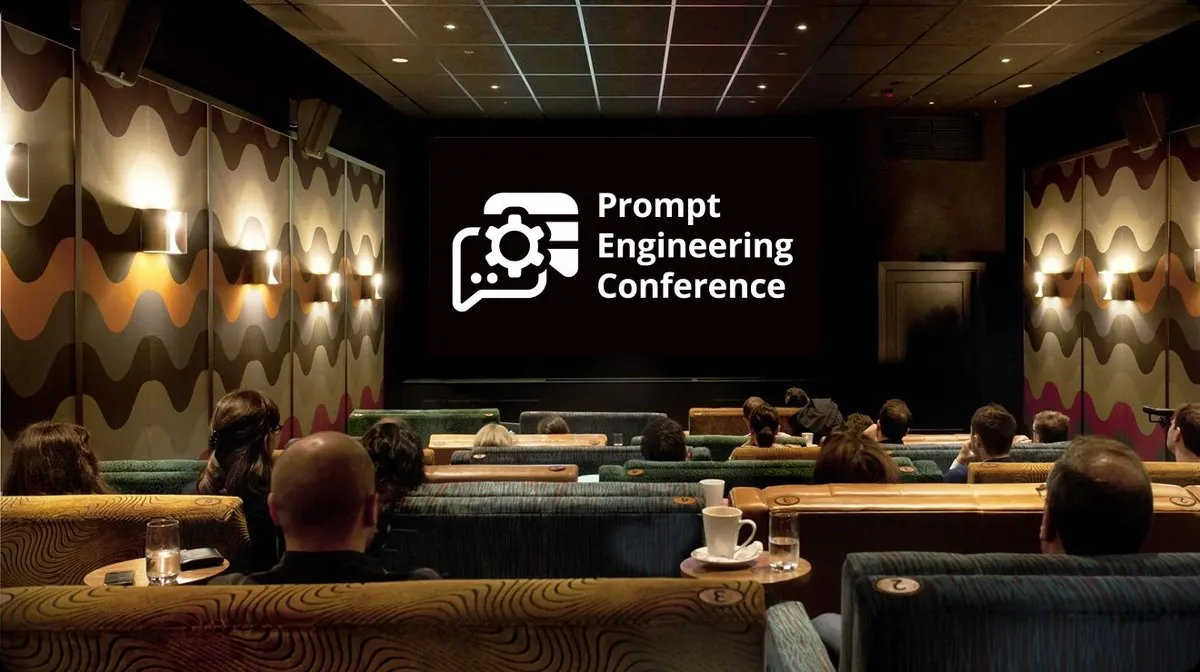
Everyman Canary Wharf

Crossrail Place,
Canary Wharf,
E14 5AR, London, UK
Level -2

Tube access
Jubilee, Elizabeth and DLR lines: Canary Wharf station
Sponsors & Partners

Want to become a sponsor? Get in touch!
Let's talk!
We'll email you and share prospectuses for relevant events.
We'd like to (one or more)
Pick at least one
Budget
Pick one